Mobile Application Development Trends To Watch Out

Mobile devices like tablets and smartphones have become an inseparable part of everyone’s daily lives. From the early morning when you wake up till the night when going to bed, how many times you use your mobile phones? For reading news, checking emails, staying in touch with friends, colleagues, and families through social media, listening music, reading eBooks, and for many other routine activities, you use your mobile phones and inset mobile applications. Moreover, the ever-increasing popularity of Android and iOS shows how mobile usage is growing by leaps and bounds. As a result, there is a bright future for the mobile application development market.

Gartner’s prediction narrates that over 268 billion mobile downloads will generate an income of $77 billion in 2017

This blog is going to enlighten you on the best and not-to-miss Top 13 mobile application development trends for the year 2017.

Most prominent mobile application development trends

Last year we had already talked about what top 13 trends were projected for the year 2016 for the mobile application development market. All those mobile application development trends are going to stay in the year 2017 as well, along with new additions. Let’s walk through each one by one:

1. More Spotlight on Security and Privacy In Apps

Along with growing mobile usage and mobile application development, the necessity to adopt best practices in data security, app security, and privacy are in the spotlight.

In accordance with the prediction by Gartner, 75% of mobile apps would not pass even basic security tests.

Hackers, in order to steal sensitive and confidential information, will learn to carry on with the tendency of misusing recognized security gaps in mobile apps. This was the greatest concern last year as well. Furthermore, this negative mobile application development trend is predicted to continue in the year 2017. In addition, one of the studies conducted by HP also mentioned that 70.6% of mobile apps can access to external storage and 94.7% mobile apps include logging methods.

However, there are some JavaScript frameworks that can help you develop a secure and scalable mobile application.

Security-and-Usage-in-Mobile-Application-Development

2. More pleasing User Experience (UX)

Trends have changed in almost all fields. Be it website designing and development or mobile application development, the main focus is better user experience (UX). Effectual display of data and content on your mobile user interface is important for a sound user experience. In the year 2017, industry experts have projected an innovative enhancement in this feature in a sensible manner. Various Android Apps and iOS Apps should make use of technologies with novel features such as interactive content layers, circular design pattern, cards and manipulation of content. Mobile users find it very easy to operate mobile apps. If those apps are not user-friendly, users will not wait for an update. They will straightaway quit its usage. Hence, the primary focus is on the more pleasing user experience of all mobile application developers, for both Android and iOS.

3. Shifting landscape of web-based app due to Accelerated Mobile Pages (AMP)

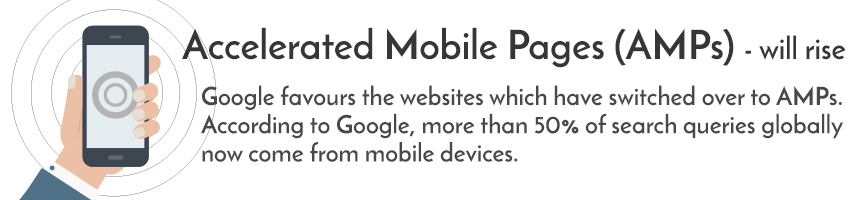
AMPs have become the common talk of the town for more than a year.Google has announced that there will be a separate search index for the mobile web. This announcement is been considered as one of the revolutions in the field of development in digital marketing. It has a significant impact on your SEO and rankings. Web-based apps that are supported by Google AMP will load much quicker on mobile devices. It will, hence, reduce bounce rates in a huge quantity. Publishers will also get the benefit of increased ad visibility and more website visitors. Hence, this trend in mobile application development is definitely expected to the rock the entire year 2017.

AMP Benifites - Mobile Application Development

4. The Trending of Chatbots

Chatbots are computer programs that imitate a conversation with users using artificial intelligence. Chatbots are getting a huge attraction to mobile apps. The most popular chatbots include Allo, Alexa, Cortana, Google Assistant, and Siri. Most mobile app developers are motivated to comprehend how chatbots work. This year, in 2017, trends indicate that most of the Android developers and iOS developers will work towards developing Chatbots. They’ll resemble human beings in the style of speech detection and personalities that lead to smoother interactions.

5. Growing Cloud-Driven Mobile Apps

Cloud computing is a pretty familiar term for almost everyone, from customers to tech professionals. Nowadays, cloud computing has marked its presence in mobile applications also. Users can expect a great upsurge in powerful mobile apps that can directly acquire data from the cloud and take minimum space in your smartphone internal memory. The Android, iOS and Windows Phone apps all have automatic photo uploads, meaning that when you shoot a photo with your phone, it’s automatically saved to your account.

Google Drive, launched in 2012, has apps available for Windows, OS X, Android, and iOS. Dropbox, launched in 2007, has apps available for each major platform and some smaller ones like the Blackberry, Linux, and Kindle Fire. OneDrive which launched in 2014 is also incorporated compactly with Microsoft Office, and it’s built into Windows 8 and Windows 10. It’s available on Windows, Mac, Android, iOS, and Windows Phone.

OneDrive, Google Drive, Dropbox, and Box are just a baby step towards it. A vast ocean is yet to explore in cloud storage realm.

Based on Cisco research, cloud apps will drive 90% of total mobile data traffic by 2019, and Mobile cloud traffic will be 11-fold with compound annual growth rate (CAGR) of 60%.

Cloud Mobile Apps - Mobile Application Development

These statistics clearly demonstrate that the mobile application development trend related to the cloud will be prominent in the year 2017.

6. Internet of Things (IoT) Will Be Much Bigger

The rapid adoption of cloud-based apps brings us to one of the latest mobile application development trends that have irritated mobile developer interest in 2016 – the Internet of Things. It’s fair enough to say that the Internet of Things (IoT) is still in its infancy. However, the way IoT is growing, it directly impacts the mobile application development trends since IoT devices are majorly controlled by Smartphones and mobile devices. Currently, the IoT is gaining traction in the fields like security, health, education, smart homes, and automobiles.

IoT integration of mobile apps will unquestionably flourish and it will be a grand move in the year 2017.

7. Artificial Intelligence Is Real Now

Based on the research of Gartner, there will be a more than 300% increase in investment on artificial intelligence in the year 2017 as compared to the last year.

Artificial intelligence (Ai) is expected to provide access to powerful insights to the business users which weren’t available earlier. This access will be provided with the use of advanced analytics, cognitive interfaces into complex systems, and machine learning techs. Giants like Google, IBM, eBay, Facebook have started acquiring startups those who are proficient in Artificial Intelligence.

Facebook-in-AI Through Mobile Application Development

Already we have seen some wonderful AI apps such as Siri, Alexa, Tesla, Prisma, and Google Now. Much more is expected in 2017 keeping the AI mobile application development trends in one piece.

Read More On – Mobile App Development Strategies For Cross Platform Developers

8. AR & VR Will Show Some Magic

In the world of modern mobile application development trends, Augmented Reality (AR), and Virtual Reality (VR) apps are getting universal for all.

Market research analysts at Technavio predicted that the global mobile AR and VR apps market will grow steadily in terms of downloads at a CAGR of more than 74% during 2016-2020.

Both AR & VR have been avant-garde in gaming & entertainment industry in the last year, 2016.

Popular examples of AR games include Pokemon Go, Zombies Run, iOnRoad, Sky Siege, Ingress, and myNav. On the other hand, VR devices that are gaining popularity include Oculus Rift, HTC Vive VR, Samsung Gear VR, Google Cardboard and PlayStation VR among others.

Based on the trends and growth in the mobile application development market, AR and VR both are expected to show some magic in the year 2017.

9. Wearable Devices Are Getting Attention

Wearable technology is one of the most exciting areas of interest for consumers. This has boosted improvements in mobile application developments.

According to International Data Corporation (IDC), the market for wearable devices is going to experience a composite annual growth rate (CAGR) of 20.3%, leading to 213.6 million units shipped in 2020.

There are some amazing wearable devices which gained huge traction from consumers and audiences in the year 2016. Such wearable devices include but are not limited to Apple Watch Series 1, Xiaomi Mi Band 2, Google Daydream View, Pebble 2, Garmin Vivomove, Fitbit Flex 2, and others.

Application of wearable devices in Mobile Application Development

These wearable devices have proved that now they are not restricted to the health and fitness sector. They have also progressed in other sectors and will definitely gain more prominence as a mobile application development trend of the year 2017.

10. M-Commerce – a growing bud in Mobile Application development realm

Instead of swiping debit cards and credit cards, nowadays, most of the customers prefer to pay through other options. Such options include the transfer of money through Apply Pay, PayTM, Google wallet and other cashless options. In short, mobile apps are slowly replacing plastic money. This is acting as a driver of M-Commerce.

Moving m-commerce from e-commerce in Mobile Application Development

Furthermore, along with the growing market of wearable devices, M-Commerce payment options will take a distinct form in the year 2017. As predicted by experts, wearable devices will play a prominent role in the future of Mobile Application Development.

The following stats throw light on the prediction of mobile app development trends.

m-commerce Market in Mobile Application Development

11. Usage of real-time geo-data from a mobile device for LBS

In order to determine your tentative location, Location-based Services (LBS) allows apps and websites (including Maps, Camera, Weather, and other apps) to use information from cellular, Wi-Fi, Bluetooth Global Positioning System (GPS), and related networks. Integrated LBS mobile applications like Apple’s iBeacons and Google Beacon are trendy. This highly developed technology gives a foremost scale to tailored mobile app marketing.

12. Swift language – ahead of other programming languages

Apple’s programming language, Swift, was first introduced at Apple’s 2014 Worldwide Developers Conference (WWDC). As a multi-paradigm and compiled programming language, Swift was developed for iOS, macOS, watchOS, tvOS & Linux.

It was included in Xcode since Version 6. This programming language gives comfort to all mobile app developers since it is built on the best of C & Objective-C minus the compatibility issues of C. Swift possess some robust features that will transform the mobile application development process. Such attributes are mentioned in the below chart:
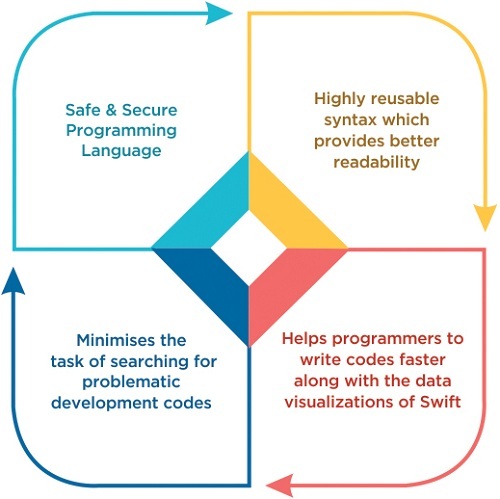
Mobile-Application-Development-Process

Swift 2 offers a host of new and developer-friendly attributes; this latest programming language is undoubtedly going to stay in the year 2017.

13. Enterprise mobile apps and micro-apps – a way to a go-ahead

Over and above, these Top 12 mobile application development trends for the year 2017, experts have also anticipated that enterprise mobile apps and micro-apps will further advance.

According to Natalie Lambert, VP Marketing at Sappho, “with more than 2 million mobile apps to choose from, most of us have installed at least 40 of them on our smartphones. Downloads from the Apple App Store alone surpassed 100 billion last years, and that number is expected to double in 2017.”

Enterprises mobile application aims to assist you to streamline, restructure and deal with critical business processes on the go. While the prime motive of a micro-app is to meet the requirements of highly targeted operations in lesser load time. However, both have gained success in the field of Mobile Application Development.

CLOSING THOUGHTS – FUTURE OF APP DEVELOPERS

Looking at the potential of mobile application development and its trends, skilled app developers perhaps need to get rid of outdated tools and trends at the development stage. Both Android app developers and iOS app developers can augment their development skills better provided they have insight into the latest mobile app development trends. Following these TOP 13 trends, certainly app developers will benefit themselves for their business.
Top 51 Content Curation Tools you need to know for your SEO

What is content curation?

When it comes to your SEO practices, along with link building, keywords, and on-page elements, content is also one of the most significant elements. Are you wondering content is still the king of SEO? Well, as per Lee OddenContent isn’t king, its kingdom. Content curation strengthens your content marketing strategy.

According to Content Marketing Institute, content curation assembles, selects, categorizes, comments on, and presents the most relevant, highest quality information to meet your audience’s needs on a specific subject.

According to Curata, 42% of companies have an executive responsible for content marketing, reaching 49% in 2017

Basically, content curation is not about creating new content. However, to a certain extent, it is about discovering and compiling existing content written by industry experts and sharing it with your online followers.

Why content curation matters?

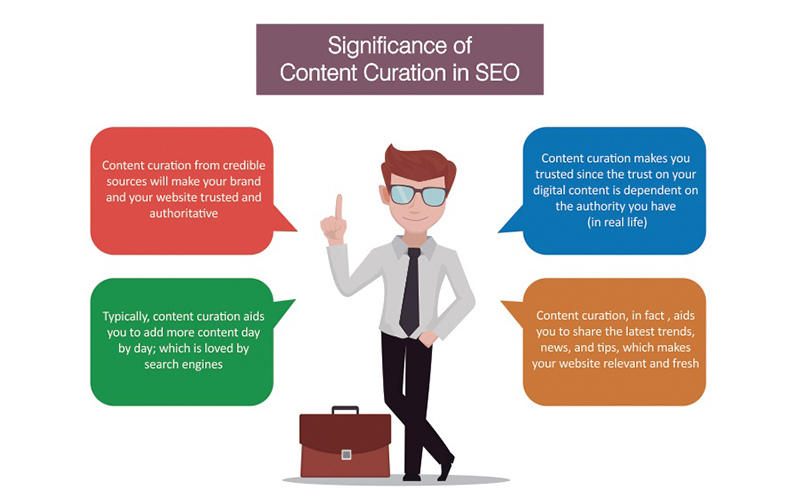
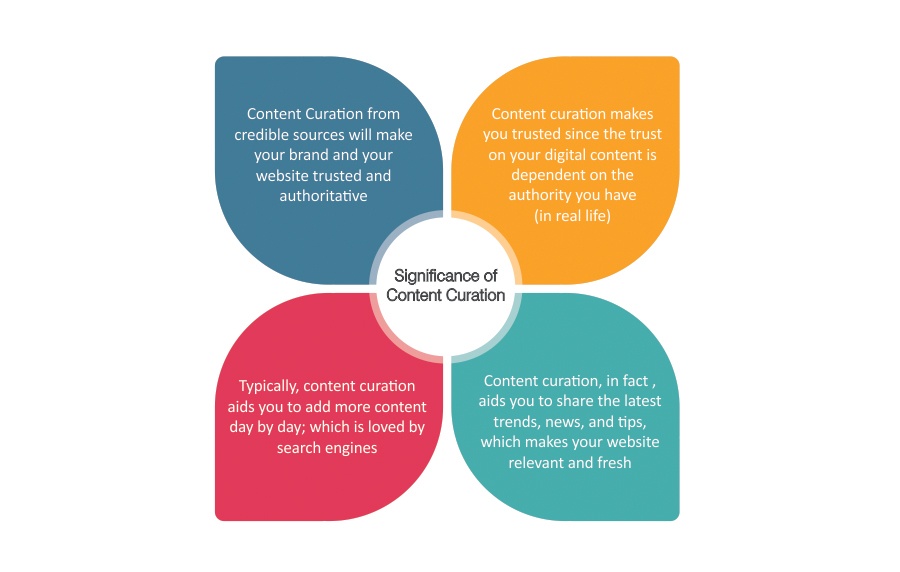
The reason why a content curation matters are simple; content curation boosts your target audience reach.  Content curation also has a role in your SEO. Of course, duplication of content will be penalized by search engines and your rankings will get hampered. But, a correct approach of content curation will augment your SEO, as mentioned below:

Significance of content curation

Furthermore, content curation will help you establish as a thought leader in your industry. The good thing about content curation is it is not restricted to sharing others’ content. You can curate your own content and share it again and again, which is called repurposing of content. Last but not the least, content curation does matter a lot for you because in this exercise you are going to learn a more about our content and your industry since there will be extensive research and reading of similar other content.

In short, to preserve booming online presence, it’s vital for you to adopt content curation as a digital marketing tactic.

How content curation helps on social media?

Content curation is more like an art rather than science. There isn’t any particular technique to be followed for any particular social media platform. In the case of twitter, curating quality content from industry influencers and sharing it on your feed will send them a notification. In turn, there are high chances that they’ll follow back you and your brand. This way you can engage with others while connecting your content with their audiences.

Content Curation Helps social-media

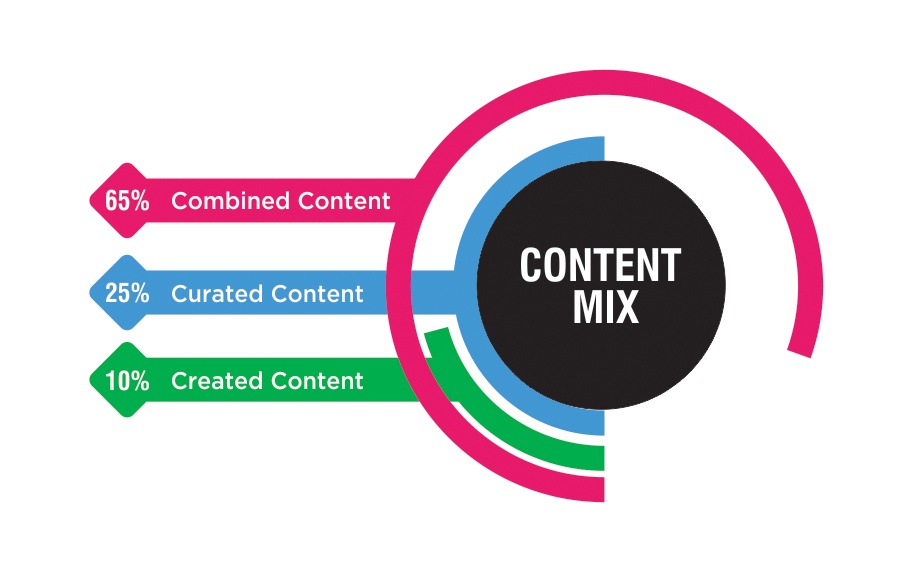
The most important thing for a digital marketer is to understand that content curation helps you build invaluable relationships while providing value to your audience. That is why your social media page should not be snowed under only curated content. Your social media page should strike an ideal balance between curated content and your own created content.

Most of the acquainted content marketers prefer a content mix in their content marketing strategy as:

content Mix in Content Curation Tool

If content curation is done right, it assists you to build valuable relationships while providing value to your audience on varied social media platforms.

What are the most preferred content curation tools?

Till now, we talked about why content curation is important. Now let us move to the main point, how to curate the content. For content marketers, content curation is integral to online strategy. Effective content curation helps position you as a thought leader in your domain. Moreover, it is an affordable way to retain a consistent publishing schedule of quality content.

“Content curation is the process of both creating and linking to pertinent content on a B2B  website”

– HiveFire CMO Richard Turcott

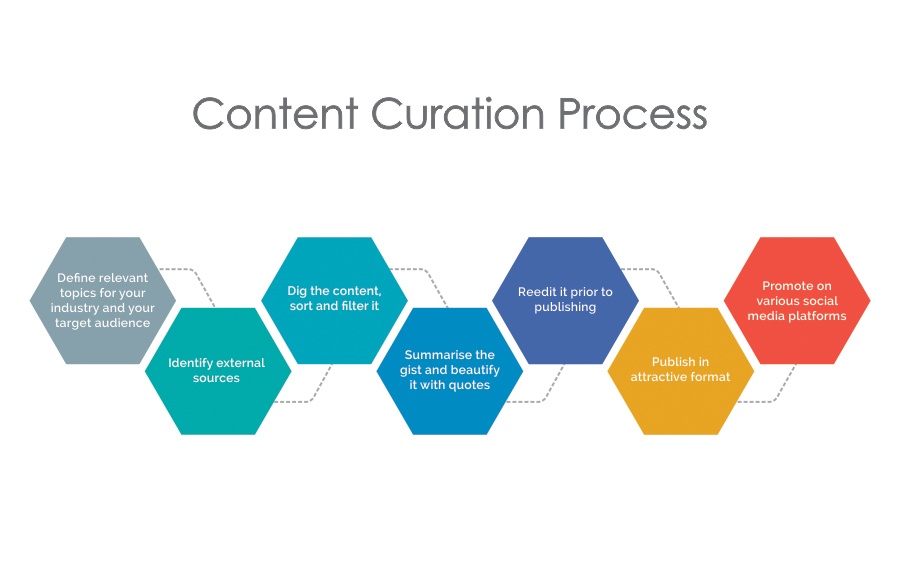
Content curation process can be graphically represented as:

Content Curation Process

However, don’t you agree, manually attempting to search for the most relevant content in a given industry and then publishing it across multiple channels can be time-consuming?

Yes, it is not only time consuming but it is also less effective. For perfect content curation, you need to take help of automation.

Here, we present the most preferred and ultimate list of content curation tools.

As we discussed in the above paragraphs, content curation is a grand manner to support a created content strategy, consistently publish content, and keep a track of your desired information sources. Let us know each content curation tool in a deeper way to understand how it can boost your overall content marketing strategy.

1. Curata

Curata Content Curation Tool

Curata is the leading provider of business-grade content curation software (CCS). Curata’s content curation software will ease you if you are struggling to scale your content marketing due to a lack of content. Curata’s CCS enables content marketers to discover fresh content, create new content, curate content from various sources, refine content flow, and publish & promote the most relevant and highest quality content as part of a successful content marketing strategy.

As a part of content curation, Curata’s CCS easily organize, interpret, and contextualize the content. Curata digs content from hundreds and thousands of relevant sources, keeping your content engine buzzing without a requirement of constant creation of your own content. It provides great support on content marketing platform by adding your own unique perspective to curated content and filtering content by relevancy & timing. CCS is best for planning, developing, and evaluating your content marketing.

According to several resources, Curata services start from $1,500 on a month-to-month basis.

2. Pinterest

pinterest content curation tool

Reading at first sight you might be surprised how can a social media platform act as content curation, right? But yes, it is indeed a content curation tool.

According to Julia McCoy, Pinterest is also fantastic for collecting useful “hacks”, tricks and tips you can build your content around

It is often called as an online pinboard. Pinterest is a visual discovery platform since it works on images, video clips, and infographics. Open your business account on Pinterest and follow people in your industry and pop culture icons to catch access to millions of great content ideas. You need to save these content ideas to interactive boards on your account and pin them. Apply these pins to curate exceptional videos, podcasts, and images content for you and for your clients.

Furthermore, the content you pin can easily comprise an image and a link that drives back to the source. The source can be either a blog or infographic. With the help of Pinterest search, you can reveal great content that is probably interesting to your audience. It is a great platform to search and share content by domain to various social platforms.

The icing on the cake is Pinterest is a free means for content marketers to discover great content.

3. Scoop.it

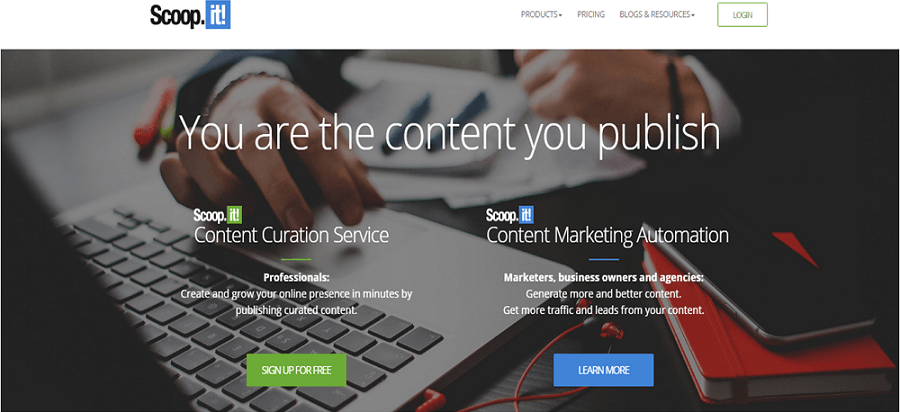
Scoop.it Content Curation Tool

A tool called Scoop.it is fantastic for content curation since it builds your relationship with other content curators. Scoop.it helps individuals and businesses to publish their content in a proficient and impacting way. This tool uses big-data semantic technology to assist you in promptly finding relevant content. Scoop.it displays the content curated by other users and offers similar topics shared. This allows you to get insight from influencers and industry leaders regarding a specific topic. It also gives you an opportunity to share your information with others and help them curate their own content.

Its top features include choosing specific keywords with the help of Boolean research, adding own sources with RSS feeds, suggesting content based on big data, and filtering content based on various criteria.

Scoop.it is a free tool; however, its paid options come with a more robust search.

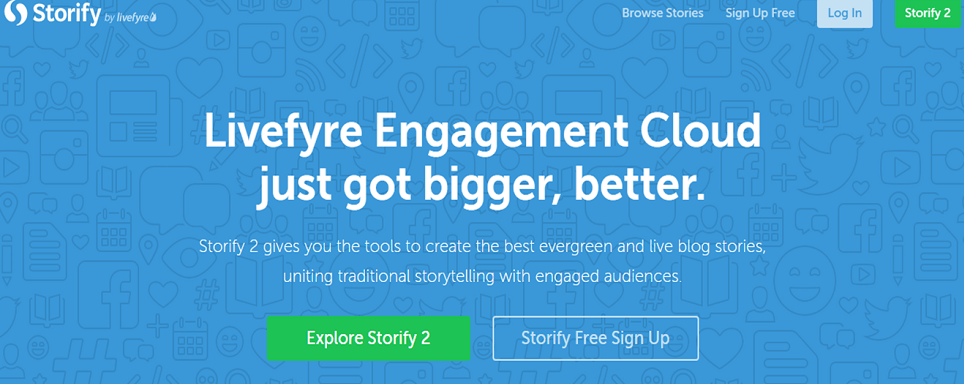
4. Storify

Storify Content Curation Tool

Storify is a wonderful visual content curation tool that creates ‘stories’ or ‘timelines’ by gathering and publishing your content from social media channels such as Facebook, Twitter, and Instagram. It is intended for organizations of any size, looking for integrating curated content into their own website or their social media page. Either you can create the content and offer people to curate the content, or you can glance through the storyboards and curate content from others.

Storify helped one woman raise $650,000 when her Storify story went viral and had 1.5 million hits

Jeff Bullas

In addition, Storify enables you to research and pool content from multiple sources, merge that content with original content, and then share the mixed content as a unique story. Once can use Storify to search blog posts, comments, and videos that others have shared online.

Storify is a free tool and it also has options of paid versions.

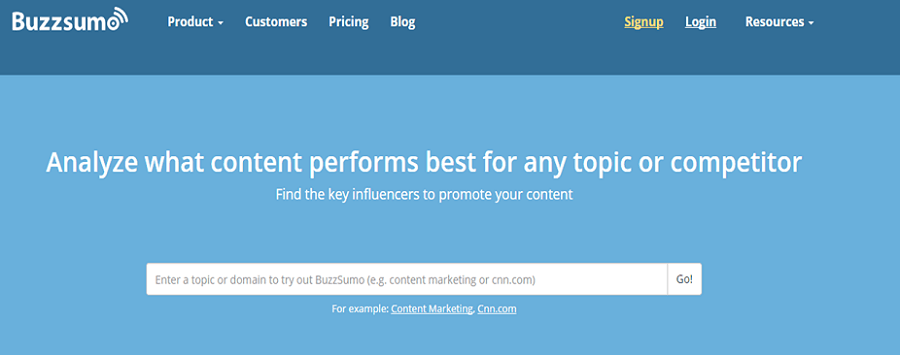
5.  Buzzsumo

Buzzsumo Content Curation Tool

Buzzsumo believes that there is ample content on internet and web pages, no shortage at all. But what matters most is to search the relevant content and use it on a timely basis. BuzzSumo gets content research to a new level using social search. The key to getting relevant content is to search using filters. You can make out the total number of shares on a particular content resource and even can identify content by author. Buzzsumo masters the art of filtering out the content that resounds with audiences, the content that is currently trending, and the content about to trend.

 Buzzsumo was a go-to resource of mine to find the most shareable content that resonated with the largest audience

Margot da Cunha

It is a highly popular content curation tool which is FREE till limited searches and then offers some advanced features underpaid options. Their plan starts from $79/month and goes beyond that based on the package you opt for.

6. Triberr

Basically, Triberr is a marketing platform for influencers. However, it also acts as a content curation tool by providing the ability to discover great content. Triberr is a community where tribes curate their own content and promote others’ content.

Either you can create an account or can log in with your twitter, facebook or LinkedIn ID to join as a tribe and follow relevant people.

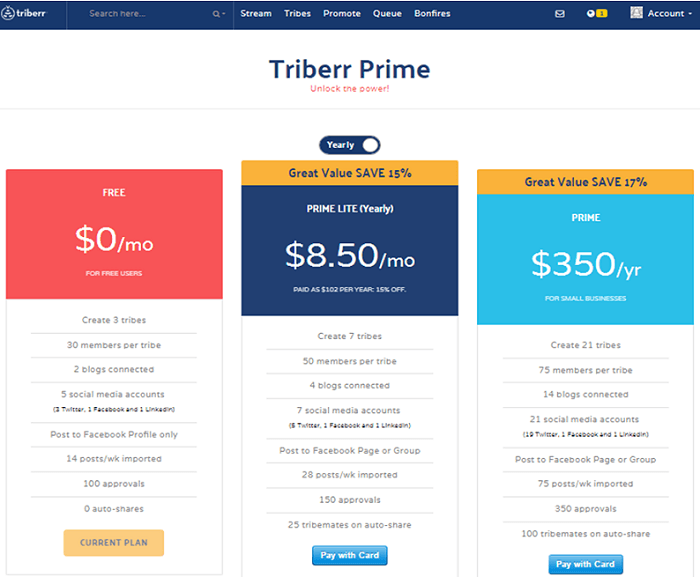
Triberr has various plans as follows:

Triberr Prime

7. Post Planner

Post Planner Content curation tool

According to Ian Cleary, The content engine in Postplanner is a great way to find content.

For smarter content, better posts, and mind blogging results – reach out to only one social media destination called Post Planner. It aids you to find the best and the right content for your audience and post it. Furthermore, it delivers content based on users’ keywords, provides status ideas, and assists users to search blogs and experts in their forte.

Post planner plans start from $9/month.

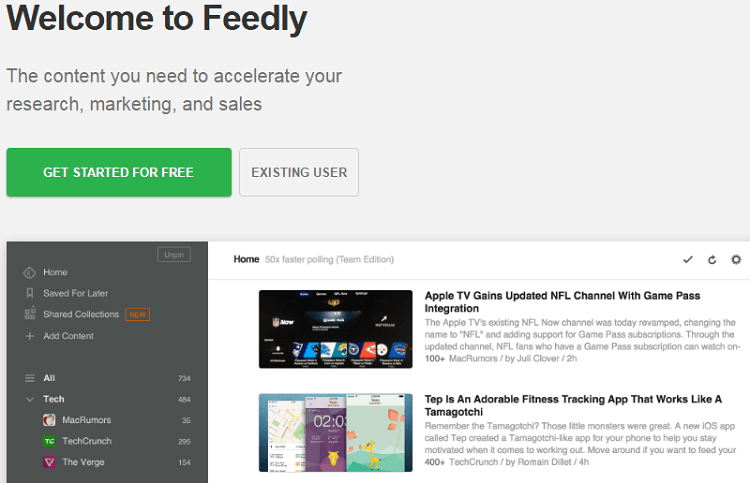
8. Feedly

Feedly content curation tool

Feedly is known for its user-friendly design. It delivers fast, mobile-optimized content using RSS feeds. Feedly enables you to browse and share content from your favourite news sites, blogs, feeds, and YouTube channels. Feedly displays the latest content being shared on a particular website or using a precise keyword on top of the entire content.

Cas McCullough : I use Feedly to categorize content for my own social platforms, as well as my clients’ platforms

Up to 100 feeds, services of Feedly are FREE, and its paid plans start from $5.41 or $18 for a team.

9. Pocket

pocket content curation tool

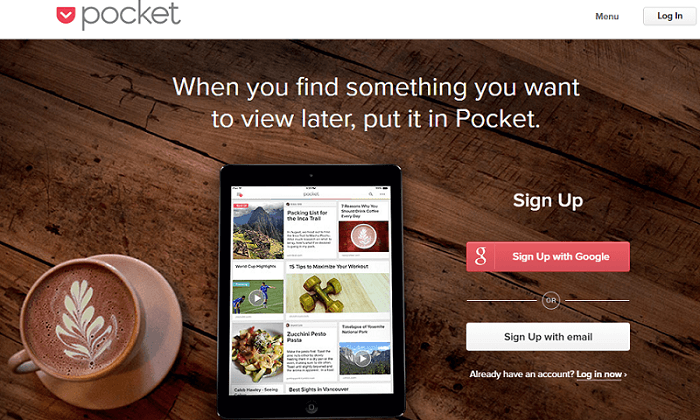
Pocket, as the name suggests, works like a pocket where you can save your content and view it later when required. Pocket provides service for saving web pages and articles. There you can view later when you want. Pocket, as a content curation tool, enables content discovery as well as arms you with the skill to search for content on specific topics. It displays the most trending and ‘must read’ sort of posts and articles.

Pocket is a great place to get into the habit of accruing content to save and share later.

Patrick Armitage

Pocket is user-friendly, can work in your browser, as well as from apps such as Twitter, Flipboard, and others. If the content is stored in Pocket, (your phone, tablet or computer), you don’t even need an Internet connection to view it again and again.

The pocket can be used for FREE; it’s paid plan starts from $44.99/yr for an ad-free experience…

10. Trap.it

Trap.it content curation tool

Trap.it is a content curation tool and a social selling service. It is considered as the best social media management solution too. It assists you to manage employee advocacy. With the help of Trap.it, you can search relevant and new content within minutes, which can be shared via email, LinkedIn or other social media platforms. Its top features include salesforce and Microsoft Dynamics Integration and Artificial Intelligence for content curation.

11. Curation Suite

Curation Suite is the renewed version of Curation Traffic. To discover, curate, publish and share multiple types of content, curation suite is the most popular platform. Curation Suite is a robust WordPress plugin that works right within your WordPress dashboard. It works with any theme and any plugin you have, to search content in the form of posts, articles, videos, infographics, and others.

Curation Suite plans start from $97 which is a one-time payment and then you can go for a top-up according to your content curation needs.

12. Quora

Quora is yet another underestimated but most important content curation tool. It is a great place to share your knowledge and ideas and engage with similar interests people. It is a forum where questions are asked and pertaining replies are given by the varied users.

You can set up an account, and then search your keywords to find outstanding content for future use. In addition, you can turn on notifications about specified topics pertaining to your field. By doing so, you can get access to more and more relevant articles and interesting ideas in your inbox.

Quora platform is FREE and can be accessed for multiple times a day

Closing thoughts

The list does not end here, there are much more content curation tools available in the market which can help you boost your content marketing strategy.  Over and above these 12 tools, 39 more tools have been listed here for you as additional reading.

Sr NoContent Curation ToolDescription
 13.Addict-o-Matic· Search the best LIVE sites across the web.
· Dig the latest and trending news, blog posts, videos and images
 14.BagTheWeb· Search, create and share ‘bags’ of web content on varied topics
 15.Bundlepost· Aggregate and plan social media content
· Find, edit, and schedule with the browser plugin or social media dashboard
16.Channel kit· Enables you to tag and organize all sorts of information in one place
· Includes articles, websites, contacts, PDF files or various format images—all showcased as neat cards in channels
 17.ContentGems· Find, curate, and share engaging content
· Boost qualified website traffic and build your company’s thought leadership
 18.Crowdynews· Mechanically integrates real-time social content beside editorial content to raise engagement and boost revenue
 19.CurationSoft· Helps establish brands as a reliable voice, and a “not to miss” source of information
 20.DrumUp· Mines web content in real-time to suggest to your audience
· Reduces your Facebook, LinkedIn, and Twitter management time
 21.elink· Offers a swift way to transform a bunch of links into content
· Enables to curate, publish, and share content online in a visually appealing manner
 22.Flipboard· Create your own personalized magazines and brochures
· Catch up on news, read stories across the globe, and browse articles,videos,and photos your friends are sharing across the web
 23.Flockler· Combine all your content, including what your fans and followers say about you, into one social hub.
·Create your own social hub or bring social content into your existing websites, applications, eCommerce sites, and other services
 24.Folloze· A great B2B platform to create content experiences that dynamically adapt to a visitor’s profile, company, industry, and stage of the deal
 25.HeadSlinger· Saves your research time by 50%, find all your news in half the time
· Scan your favourite sites’ headlines in a matter of seconds and store your favourite news sources in a swift and simple manner to find folders
 26.Huzzaz· Video curation platform that enables you to search, mine, collect and showcase   YouTube and Vimeo videos
· Analyze user’s viewing behaviour and figure out which videos matter most to your viewers and to enhance the site engagement
 27.Juxtapost· Swift, simple and FREE way to bookmark online images
· Gather and handle categorized post boards
 28.Kbucket· Being it a user indexed search site, here, skilled “content curators” categorize, comment, tag, and publish their research to support their content marketing strategy
 29.Curator· Persistently publish fresh and new content on websites or blogs in minutes a day to keep up readers engagement
 30.LinkHubb· Curate and share multiple links from around the web in one organized page, upload documents and files to the cloud, and use affiliate technology to generate ad-based revenue
 31.List.ly· Curate, crowdsource and engage readers via LIVE rooted list content inside blog posts
 32.Newsle· Track users’ Facebook friends, LinkedIn connections, and email contacts in the news. By no means miss a key story about a follower, professional contact, or public figure
 33.papaly· Bookmark management and discovery tool
 34.Paper.li· Publish ‘newspapers’ comprised of content from anywhere on the web to treat your readers to fresh news daily
 35.Pearltrees· Visual and collaborative curation tool. Allows you to collect, organize, and share any URL, and upload personal images and notes
 36.Pluggio· Secure web-based system that helps individuals, businesses, organizations and marketers easily grow and manage their social media profiles
 37.RebelMouse· Create a blog, website, or social page in seconds. Simply connect your social networks such as Twitter, Facebook, Instagram, Google+ or LinkedIn.
 38.RockTheDeadline· Simplifies for brands, agencies, and publishers to create and manage compelling content
·Curate timely and trending news and promote that content over multiple channels
 39.Roojoom· Create Smart MiniSites, online magazines, and e-newsletters
· Content can be personalized to increase engagement and improve conversions across the customer life-cycle
 40.Shareist· Capture bookmarks and ideas, share them on social media and save them for building and publishing pages to blogs
 41.Sharpr· Segregate information silos, advance collaboration, and share what matters most with the users who matter most to your business
 42.Spredfast· Helps brands, media, and agencies involve and connect with audience integrating social media into their marketing and advertising efforts
 43.sprinklr· Helps brands and organizations distribute curated social media content to support their content strategy. Platforms include websites, event displays, retail signage, and mobile apps.
 44.Storyful· Helps newsrooms find the most valuable content on the social web. Uses a “human algorithm” to sort through verified curated news from various mediums.
 45.Sutori· Create and share visual stories, collaboratively
 46.symbaloo· A personal Startpage that allows you to easily navigate the web. Compile your favourite sites into one visual interface. Save your bookmarks in the cloud and access them from anywhere with any device.
 47.TagBoard· Social media hub for hashtags
· Collect, moderate, and follow hashtags, as well as create and follow your own hashtag conversations
 48.The Tweeted Times· Comprehends news in your Twitter flow every hour
· Ranks each section by its popularity amid your friends
 49.UpContent· Content mining and content curation tool that crawls the web to draw news, articles, and blog posts
· Sorts by parameters such as the social influence
· Reduces browsing needs of surfing 1000s of page results
 50.Vidinterest· A platform to discover social videos that enables you to bookmark videos and create private or public playlists of videos
· Allows surfing any website featuring videos from Vimeo, YouTube, and Daily Motion.
 51.Waywire· Video curation tool that embeds hundreds of top-quality sources from trusted
media makers to improve your site with current, timely, trending and contextually-relevant videos

Again, this is not an exhaustive list of content curation tools. Feel free to drop in the comments section if you use any of the other tools and how is your content curation experience with that content curation tool. We are excited to hear from you regarding your insights on content curation tools!

How To Make Money In Affiliate Marketing?

Introduction to Affiliate Marketing

Affiliate marketing is now not a new concept, but it is still a very fresh and rewarding way of marketing online. It is about a relationship between three main parties: the affiliate (publisher), the merchant (advertiser), and the customer. Furthermore, affiliate marketing is one of the most popular ways of making money online.

Affiliate Marketing

It offers a low-cost technique for traders and dealers to display their products and services and build brand awareness.

Geno Prussakov has mentioned in of his blogs that 38% of marketers call affiliate marketing one of the top customer acquisition methods.

What is affiliate marketing?

An affiliate marketing model is straightforward; it acts as a commission-based recommendation practice. A partner or affiliate promotes a trader or a dealer’s products for a slice of the pie. Affiliates are as good as extended sales and marketing departments of the merchants. They play a major role in your marketing campaign and assist the customers to choose products and buy them online.

According to a study, in most affiliate programs less than 10% of affiliates drive 90% of traffic and conversions.

Make Money in affiliate Marketing

Affiliate marketing is performance-based marketing. Despite affiliate marketing doesn’t require a fate and years of struggle to get started, you shouldn’t presume excellent results overnight. It is intensely competitive and you need to dedicate productive time for choosing products and ensuring that they meet market needs. Consequently, learn how to promote them and how to measure the success of an affiliate marketing program.

How to become an affiliate marketer?

Let us have a look at the traits of a successful affiliate marketer. Typically, an excellent affiliate possesses the following traits:

Become an affiliate Marketer

To become a successful affiliate marketer is not a tough job; it is a simple process as shown below:

1. Discover an exclusive niche

As a secret success formula, do not try to straightaway offer anything at all. Rather, stay focused on a precise niche market. Figure out your audience, analyze their pain points, offer them solutions to solve their issues, and ultimately assist them to achieve their goals. To identify the service area which can work best for you and your audience, the best place is to visit forum and question answers’ websites of your industry.

2. Make powerful use of search engine marketing

Search engine marketing is a powerful mechanism for online businesses. After assembling affiliate storehouse, jump into its timely and logical promotion. The preferred option of most of the affiliates is pay-per-click. However, to reap long-term benefits use a proper blend of organic search and paid search. PPC can definitely give you instant results but if you rely only on PPC for a longer time, all your profits might end up in the hands of Google Adwords.

3. Understand Your Product and Identify Your Audience

This is a complete analytical exercise. You need to devote your time in knowing your product and knowing your audience. Create a database, you will find it handy as and when required glancing through. Learn in-depth about the products and/or services. Think about the value you can provide to your customers along with your products/services offerings which can help you to build your credibility. This is because trust can be earned from credibility builds trust.

Have a psychological study of your audience.  This will help you in developing and designing a web site that converts well and ultimately boosts your ROI.

4. Don’t ponder all your prospects or resources in one thing or place

This is the excellent tip to become a successful affiliate marketer. Promote products from diverse merchants. This way you will be able to balance the cash flows.  Furthermore, out of multiple merchants, if one or two fail to promote your product, the overall impact on your business will be minimal. It is absolutely fine to opt for diversification and promote niche products from diverse merchants.

5. Gain excellence in internet marketing

Internet marketing is a very dynamic field. On an ongoing basis, trends keep changing. You need to act intelligently here to succeed. Keep yourself updated with the latest trends, tips, and tactics.  In order to become an expert affiliate, you must always dedicate your time in reading, learning, and embracing the dynamics of Internet marketing.

6. Monitor your efforts

As an affiliate, don’t give up if it doesn’t reach the satisfaction levels. Try and try, again and again. Monitor your efforts and analyze your statistics, to figure out what is working well and what is going wrong. Accordingly, amend your affiliate marketing strategy.

How does affiliate marketing work?

affiliate Marketing Works

Affiliate marketing works on click; by clicking on a special hyperlink made available by the particular affiliate program. The most common type of tracking is tracking via a cookie. When a user clicks on the link, a cookie is stored on their computers. This cookie lets the merchant know that in case a sale transaction happens, it has come from you.

To get started with affiliate marketing, the first step is to sign up for a partner program. On getting login details, you will be assigned a link with a unique ID that makes it feasible to track all traffic sent by you to the advertiser’s site. If your visitor clicks on it and performs the qualified action, you will receive a commission. Qualified action depends on the compensation model. The most commonly used one is pay per sale model which is based on the revenue sharing when a merchant pays an affiliate the percentage of the sale.

Affiliate marketing works best in three types of products /services promotion where it has shown highest success till date:

1.  Information productscan make you earn commission up to 50% since they are cost-effective; production costs are lower as compared to prospects they offer
2.  Physical productseasiest to sell but churns out a lesser commission (not more than 5 to 10%) since most of the amounts get deducted in variables like shipping, wholesaling, and others
3.  Servicesbased on trends, one can normally expect commission in the range of 10 to 30%

Over 50% of topmost affiliate programs fall into these FOUR categories: Fashion, Sports, travel, and Health & Beauty.

Affiliate marketing can provide you with a stable stream of income. How much you can earn entirely depends on how successful you are in converting your browsers into buyers and service subscribers. Affiliate marketing is cost-effective; the place is not important, you can work from anywhere in the world and still earn handsome amounts.

How to make money as an affiliate marketer?

Make Money as an Affiliate Marketing

Affiliate marketing experts often make an income that can tally over five figures per month, however, only 1 to 5% of thousands of marketers literally achieve this level. When an affiliate reaches this elite level, they are often referred to as a “super” affiliate.

“Affiliate Marketing Has Made Businesses Millions And Ordinary People Millionaires. Affiliate Marketing may be Your Next Best Career Move.”

Bo Benette

If anyone asks can you make money with affiliate marketing, the precise answer is “yes”. It is true that affiliate programs can earn extra money and even a full-time income from home. The long answer is a little more complicated. Like any home income venture, success comes not so much from what you choose to do to make money, but whether or not you do what needs to be done correctly and consistently.

Affiliate marketing is the ultimate home business since it has no dependence on finance to get started. Furthermore, neither you need to manufacture, stock, ship product inventory, nor you need to deliver a service on demand. Under affiliate marketing, you are fundamentally paid for referring new clients and customers to other businesses.

[A] Affiliate marketing WITH website

It is better to do affiliate marketing with a website. Once you have figured out your niche and have zeroed down your research on an affiliate marketing program, the immediate step is to build your site.  For a newbie in the realm of building sites, an easy option is to go for WordPress. Since the WordPress CMS provides ease in operation and coding skill required is zilch, you can set up your own site effortlessly.

Make sure that you go for the authorized domain for better authenticity of your site. And, the content which you publish on your site should be of excellent quality. Your content plays a major role in your overall marketing strategy.

Content is not just king, its kingdom.   Lee Odden

The type of content could consist of product reviews, banner ads, blog posts, common questions and answers (FAQs), informational content, etc. In your blog posts, you can mention about your products, how it helps your target audience, why they should buy it, what are the common issues with the product and how to deal with it, etc. Coming to the informational content, you can have a tab of FREE resources wherein you can add some slideshow, presentation, tutorial, EBook, etc. all these tactics will bring traffic to your website. In case your product is admired enough and brings sufficient relevant traffic to your website, you could also monetize the traffic in other ways, such as AdSense.

Promotion of website and content

Once your website is ready with relevant content, the next step is the promotion of your website and your content on various social media platforms. On the basis of your niche, you can choose from Facebook Twitter InstagramPinterest, Google+, LinkedIn, and several other niches and location-specific networks.

Now, everything is ready for your affiliate marketing, starting from website to content and social media. Once all requirements are fulfilled, you can straightaway go ahead with the promotion of affiliate offers.

Remember, under affiliate marketing, merchants only pay for actual customers, not just visits. This gives affiliate marketing a major benefit over other promotional channels, such as PPC, where it’s trouble-free to spend a large chunk of money on clicks without producing any actual conversions. Successful affiliate programs use the multi-channel acknowledgment to ensure the affiliates that create the most value get paid the most.

According to Bill Burnice, top  affiliate networks for 2017 are:

  • Clickbank
  • Rakuten
  • Amazon Associates
  • ShareASale
  • eBay
  • Avangate
  • Flexoffers
  • Avantlink
  • Revenuewire
  • ReviMedia
  • AdCombo
  • AffiBank

[B] Affiliate marketing WITHOUT having a website

It might be sounding absurd, but yes, you can do affiliate marketing without having a website also.

  • You can start posting the products which you want to promote on blogs and forums with your affiliate link in your signature
  • You can take help of EBook as a promotional scheme. Go for writing a ‘viral’ book and post on sites like eBay. An informative and useful book as compared to simply laden with affiliate ads might get quite better traction from your target.
  • Video marketing is one of the most prominent content marketing strategies as per SEO Trends 2017. Hence, go for sites like YouTube and Vimeo and promote your video clips. You will surely convert a good amount of fan base into affiliate profits.
  • A simple yet effective technique is to write classifieds for the products you want to promote and submit them on various sites. Classified submissions are regarded as one of the most favoured marketing prompts for affiliates who don’t use websites.
  • Build your own social network and let your followers know about you and the products you promote.
  • Write guest posts for the website having high traffic.
  • Little less recommended method is PPC. Because promotion through pay-per-click technique involves creating PPC campaigns through search engines like Google and Bing, and promoting the merchant website directly through your affiliate link.
Affiliate Marketing WITHOUT having website

Closing thoughts on affiliate marketing

The problem with affiliate marketing, like many other home business options, is the self-styled sages and get-rich-quick programs. These sages and programs hint that affiliate marketing can be done fast and with little or zero effort. So, the issue isn’t really whether or not affiliate marketing is a viable income option (it is), but whether or not you  can make affiliate marketing work for you. Affiliate marketing isn’t hard, but it does require knowledge, planning, and consistent effort to make any significant income.

Know the best marketing automation tools for your business

According to HubSpot, “Marketing automation refers to the software that exists with the goal of automating marketing actions.”

Many marketing departments perform various repetitive and monotonous tasks. These tasks include, but are not limited to emails, social media, and other website actions. The marketing automation tools make these everyday jobs easier. In nonprofessional terms, marketing automation is all about optimisation. The scope of marketing automation is beyond simply automating the marketing department’s repetitive tasks. In addition, it optimises the time of your staff. It can even hint on which customers your sales team concentrates their endeavours.

Digital marketing automation has its bloodline in email marketing. However, it is way beyond email marketing. Marketing automation aids marketers to restructure various actions like generating, scoring, and nurturing leads, managing link selling, cross-selling and up-selling, customer lifecycle marketing, and others. The efficient implementation of marketing automation technology can effectively increase operational efficiency. The technology helps to grow revenue quicker by cutting your sales cycle, recovering your lead aptitude, and saving you time to focus on other important areas. However, unfortunately, these paybacks can be availed at a giant cost.

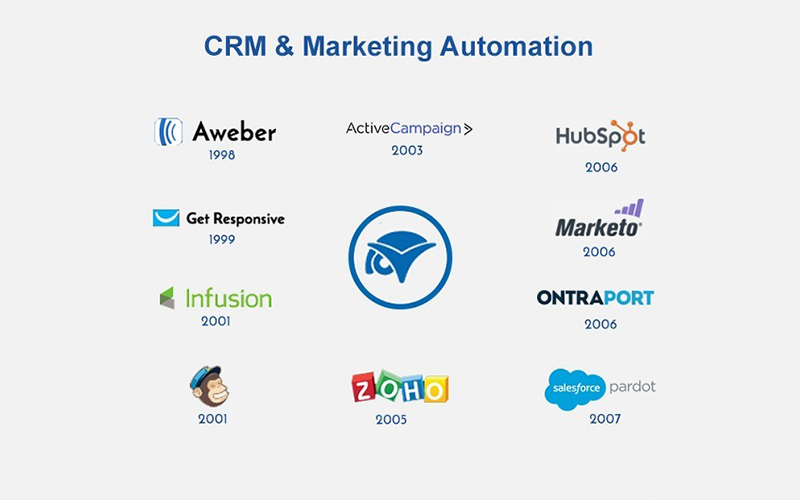
Marketing Automation

1. Infusionsoft

Clate Mask and his brother Eric Martineau, Scott jointly established Infusionsoft in 2001 at Mesa, Arizona. It caters to more than 25,000 customers. Infusionsoft is one of the most successful marketing automation tools for small businesses that already have a strong customer base and a turnover above $100,000.

Infusionsoft, a leading sales and marketing software, supports small business in getting structured, building sales, and saving time. Its user interface is very well designed. Very few marketing automation tools offer order forms, payment processing, execution, and inventory tracking directly inside the tool.  Infusionsoft is one of those automation tools. In addition, it allows worldwide tracking, which makes it easy to keep a track of a contact’s behaviour across multiple marketing channels. Besides, a lot of bloggers use this software for email marketing and creating marketing campaigns & funnels.

Infusionsoft expedites the creation and execution of a sales and marketing strategy. It centralizes customer interactions, attracts new leads, meets sales quicker, and automates recurring tasks like a follow-up, contact management, billing, and payment—all from one place.

Infusionsoft charge a unique mandatory launch fee of $1999.

infusionsoft Marketing Automation

2. ActiveCampaign

Again, this automation tool is the best-fit solution for small businesses having the strength of less than 100. This tool is very reasonable compared to others. You would be amazed to know that it costs a maximum $150 per month. ActiveCampaign provides services like unlimited email sending, CRM and sales automation, onboarding, and unrestricted access to social data.

Though it is very affordable, the automation features that ActiveCampaign provides are robust. The features include sales team notification, cart and form abandonment, visual workflow editor, and web traffic analysis. The interface of this software is so straightforward that anyone can operate it with ease. The reason why ActiveCampaign should be preferred by small businesses is pretty obvious. The platform makes lead generation and warm lead nurturing effortless by excellent CRM and mailing solutions.

ActiveCampaign Marketing Automation Tool

3. Hubspot

In 2006, HubSpot was founded by Brian Halligan and Dharmesh Shah at the Massachusetts Institute of Technology (MIT). It was launched in December 2007. Since ages, HubSpot is one of the pioneers in automated digital marketing. It is an inbound marketing software company that helps businesses in modifying their marketing from outbound lead generation to inbound lead generation. It does it by allowing them to “get noticed” by more potential customers in the usual course of the way they shop and learn.

They “get” content marketing.

It provides a full suite of integrated marketing tools that comprise blogging, content management, search engine optimization, social media publishing and monitoring, email marketing, and more. HubSpot is a complete platform for developing marketing effectiveness and marketing competence.

Hubspot does have monthly packages of $200. However, their offerings cost $800/month package for marketing automation and CRM integration that includes only 1,000 contacts. The further cost grows based on the user’s contract requirements.

Hubspot Marketing Automation Tool

4. Marketo

Marketo, founded in 2006, launched its first product “Lead Management.” In 2012, Marketo acquired “Crowd Factory.” This acquisition resulted in the benefits of social media marketing capabilities. Finally, the company went public in 2013.

Marketo is easy and influential marketing software that suits an organization having the strength of 100+. It helps marketing and sales professionals drive revenue and develop marketing engagement. Most of the users usually compare this software with Pardot owing to their similar functionality.

Marketo overpowers Pardot in terms of implementation, usability, and design of their platform. Marketo provides the foremost cloud-based marketing software platform for companies of all sizes to develop and maintain engaging customer relationships. It has an outstanding integration with Salesforce. These two tools work effortlessly together through their syncing takes a considerable amount of time.

The packages of Marketo include three standard pricing tiers, at $895, $1,795, and $3,175 per month. Under each tier, various new features are available which may come at hefty prices of an additional $900 – $1,400 per month.

Marketo Automation Tool

5. Ontraport

Ontraport is again very good for SMBs, the affordability factor is just as important as a feature. It allows accessing the full suite, along with a money-back guarantee only at $600/month. The topmost features of Ontraport include but not limited to two way SMS automation, Landing page A/B testing, ROI tracking, custom reporting dashboard, video hosting, API access for third-party development, task management automation, and lead scoring and routing.

Ontraport holds a wide range of inspiring shopping cart features. These features comprise automatic credit card payment collections and the ability to add cross-sells, upsells, and cart rejection orders.

Ontraport allows storing 25K contacts, managing 100K contacts, and sending 100K emails per month.

Ontraport Automation Tool

Do Not Miss: to Read About Important 5 Essential Marketing Automation Tips for Successful Start-ups


6. Pardot

Pardot belongs to Salesforce. It was jointly founded by Adam Blitzer and David Cummings in 2007. In 2012, Exact Target acquired it for a reported $95 million. Later, Salesforce acquired Exact Target in 2013.

It is a full-featured and user-friendly marketing automation tool. It helps pipelines to pick up the pace and drive sales through social marketing, sales intelligence, email marketing, lead generation, lead management, and more. Other prominent features include segmentation wizard, ROI reporting, email marketing with complete branded templates, real-time sales alerts and CRM integration. It maximizes the efficiency of the sales and marketing teams and ultimately increases revenue.

The standard package provided by Pardot comes at a cost of $1000 per month. The other packages related to advanced analytics, A/B testing, dynamic content costs around $2000 per month. The ultimate package related to API access and custom user roles is of $3000 approx per month.

Pardot Automation Marketing Tool

7. GetResponse

GetResponse Marketing Automation facilitates you to devise flexible processes that sustain your unique business style. Also, can transform your marketing database into a lead scoring activist. It is highly efficient in optimizing the sales funnel. The top features of GetResponse include but not limited to drag and drop visual workflow editor, post-purchase communication, loyalty and reward programs, tracking online activities of subscribers, cutting-edge customer scoring, and others. This platform is very simple to operate; you need to have a full-time CRM manager. Its monthly payment plans are sectioned by list size which starts at $15 per month for unlimited messages to up to 1,000 subscribers.

GetResponse Automation Marketing Tool

8. MailChimp

As an email marketing automation tool, MailChimp is a preferred choice for many SMBs.

MailChimp provides enterprise-level automation tools without any hurdles. Its prominent features include but not limited to trigger emails when customers abandon shopping carts, conversion of interested subscribers into customers, re-engaging with existing customers, integration of web services with apps, and others.

There are three pricing plans offers of Mailchimp: Forever Free, Monthly, and Pay As You Go. They also have an alternative designed to fit users’ needs.

9. AWeber

AWeber is an ideal autoresponder platform for small businesses, bloggers, and entrepreneurs. This marketing automation tool is a comfortable process to automate your emails. Its new drag and drop editor is capable to support your email automation requirements. Its prominent features include lead segmentation, web activity tracking, creating invoices, split testing, generating sales reports, and others. AWeber enables you to assemble your list with their opt-in forms. It sends out automated emails to your subscribers. If you want to get started with email marketing, AWeber is the perfect key.

AWeber Automation Marketing Tool

10. Zoho CRM

Zoho Campaigns is an email marketing automation product that helps you create, send, track, and share your email campaigns. Its free services include 12000 emails/month, 2000 subscribers, pre-designed templates, real-time visitor tracking, template library, A/B testing, social sharing, merge tags, sign-up forms, and many more.

Zoho CRM provides a complete view of your sales cycle and pipeline. Zoho. Thereby it enables you to spot trends, marking opportunities, and further, lock more deals. Zoho’s shaped customer relationship management and marketing effectiveness procedures help you build your company into a customer-centric business. Its campaigns are integrated with internal services like Zoho Survey, Zoho CRM, Zoho Forms, Zoho Docs & Zoho Sites, Zoho Creator, and other services like LinkedIn, Shopify, SurveyMonkey, Facebook, Twitter, Eventbrite, Google Analytics, WordPress, Google Apps, and others.

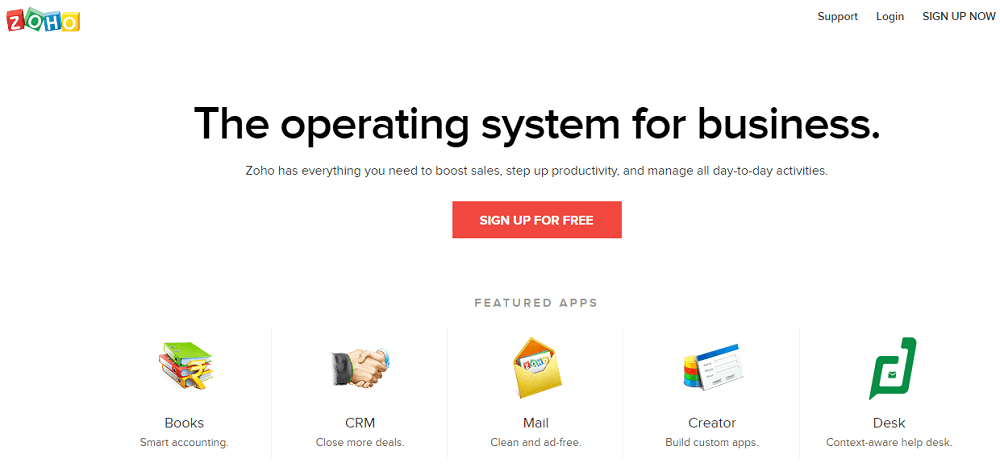
Zoho Automation Marketing Tool

Its service packages are in affordable ranges. $12/user/month package provides services of sales forecasting, reports, and dashboards. A professional package worth $20/user/month provides services of Email integration and social CRM. An enterprise package worth $35/user/month provides services of territory management and custom modules. Further, its CRM Plus package worth $50/user/month provides services of email marketing, help desk, and customer surveys.

How To Develop A Winning CRO Testing Roadmap

Conversion Rate Optimization (CRO) is the practice which boosts the proportion of your website visitors who perform a preferred action on your website. Primarily, it is website optimization so that larger chunk of your traffic finds it illuminating and performs your desired action.

Conversion-Rate-Optimization

Need for CRO testing roadmap

A number of variables need to be tested in order to achieve your conversion goal. These variables include:

  • Opt-in form placement, design, and draft
  • Opt-in bribe (or lead magnet)
  • CTA (“call to action”) color and copy

Testing such variables might lead you to cash on short-term success like increasing CTR to your landing page. However, to enjoy long-term and sustained success, you need to focus on CRO testing roadmap. These long-term goals include increasing MRR. Consequently, it is must to test CRO roadmap. This is because as a business it helps you to move from tactical testing to strategic testing. Based on positive results, you can optimize your focused areas of website. Moreover, it improves organizational resource planning.

According to Emma Travis, Senior Optimization Strategist at PRWD, having a testing roadmap “helps to communicate to the wider business what the ‘plan’ is.”

The major paybacks of developing a roadmap are better alignment of teams with brand visions and strategic goals. It sharps your testing in conjunction with the widespread organization and how you accomplish your goals.

The broad reasons why you need to develop a winning CRO testing roadmap includes the following:

1. Optimize resource planning

Few areas you need to decide based on your requirements, though trial and error may require. Such areas include hiring resources over outsourcing. Content writer, web designer, developer, and other vital resources can either be hired for temporary or full time basis. Considering costs and benefits, you may opt for outsourcing the same tasks. However, to decide – hire or outsource, a roadmap helps you know exactly when to hire resources for maximum impact. For example, if your roadmap reveals that you will not be testing copy till the next quarter, you can postpone on hiring a copywriter. Such tests if performed timely and wisely can save you from over-hiring and under-hiring. Ultimately, improves targeted results and your outcome.

2. Focus on strategic goals over tactical goals

In order to achieve strategic goals, one definitely needs to achieve tactical and operational goals. All long-term strategy should be wisely segmented into tactical and operational strategies. However, it does not mean that you should divert your mindset and only focus on operational or tactical goals. For example, if your tactical goal is to increase CTR by 40% and you achieve it as well. Still, it remains your short-term success only. This is because “increasing CTR” is a tactical objective, not a strategic business goal. You may see a drastic improvement in your CTR but is possible that you end up losing on revenue. It improves a specific, remote metric (CTR) without considering long-term goals. Here, a testing roadmap fundamentally outlines these tactical goals in outlook. You know precisely how short-term, tactical goals merge with long-term strategic goals.

3. Prioritize tests

Here, you may pick up any sample page of the website, say product/service page. On this page, you may run a number of tests. Such tests include:

  • adding “Zoom” element,
  • appending a size, fit and flex rating,
  • detailing UGC (“user-generated content”) of product images,
  • attaching “Customer Q&A”,
  • making CTA button even more prominent

4. Perform more complex tests

Often, a user restricts him with simple tests including changing font, page colour, button colour, or even tweaking a headline. Possibly, one can make the modifications in coding as well. These changes are fairly easy to work out. On the other hand, more complex tests require a number of resources working together to run the test. In larger organizations, even a team of the tester is required to sign-off on a complex test prior to running it. Such changes include modifying checkout page design to focus on free shipping, tweaking pricing table, and others.

Again, here, a testing roadmap can let you know precisely whom you need to bring on the project. For example, if you need the designer team to sign-off on a checkout page design test, you can employ them at the appropriate time.

5. Line up the rest of your business with your vision and mission

Last but not the least, especially for larger businesses, alignment of resources with organizational vision and mission is must. CRO repeatedly requires a huge amount of modifications to your business, website, and sometimes, even your business model. Undoubtedly, a testing roadmap ensures that your entire business has perceptibility into these developments.


Do Not Miss: to Read About Important How to Optimize Landing Page to Improve Conversions


How to construct a CRO Testing Roadmap

Construction of CRO testing roadmap is a subjective matter since it differs from business to business and industry to industry…

Moreover, the field of CRO has yet not fully evolved. In spite of the availability of numerous frameworks, most of the consultants use their own customized approaches to develop a testing roadmap. Experts suggest the following simple steps construct your own CRO testing roadmap:

1. Clarification of business vision and mission

As a business, it is imperative to establish your business goal. Importantly, goals need to be SMART i.e. specific, measurable, achievable, realistic, and tangible. With reference to CRO testing roadmap, you need to have consent on how the goal is measured. It should be noted that goals relate to business and industry and could be completely different from one business to others. For an e-commerce company, a goal could be “reduce shopping cart abandonment,” while for a SaaS startup, it could be “reduce churn rate.”

Your business goal would be the course of action behind every test you run. Any test that does not help meet your goal in some way should not be run.

business vision and mission

2. Drill down strategic goals to meet the business goal

Your business goal needs to be drilled down to the level of your strategic goal. For instance, if your e-commerce business goal is to “improve the shopping cart acceptation rate”, your strategic goals could be:

  • Augment checkout completion rate
  • Boost product prices
  • Enhance cart recovery email conversion rate

Enlisting such strategic goals with the help of various mind-mapping tools will ease your process of developing CRO testing roadmap.

3. Collate tactical goals to accomplish strategic goals

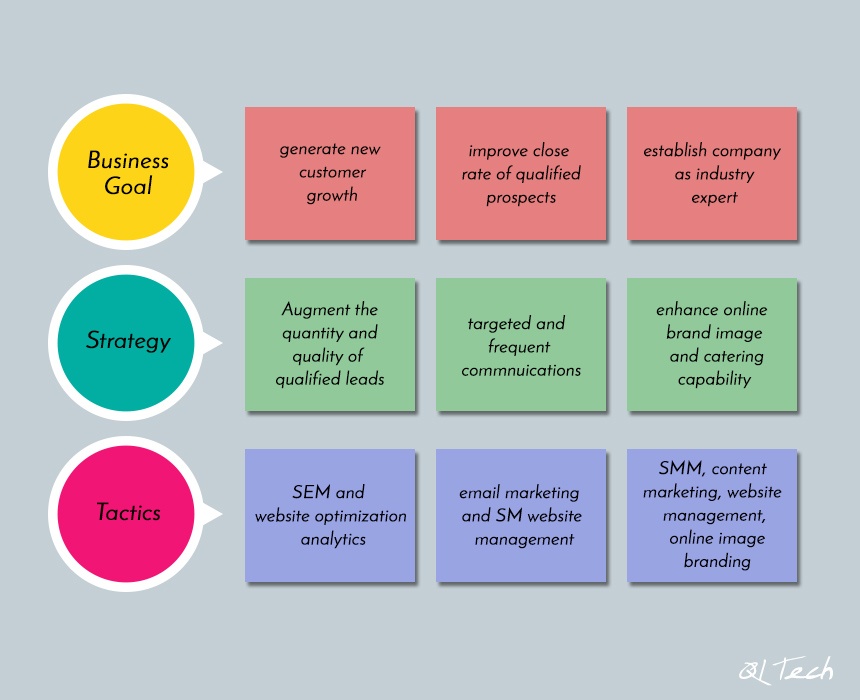
You need to achieve your tactical goals to accomplish your strategic goals. For example, suppose you own a digital marketing firm, your strategic goals and tactical goals could be as follows:

Business Goal and strategy

These tactical goals form the foundation of your testing idea brainstorming session.

4. Document on hand performance and set a baseline

Prior to moving towards brainstorming testing ideas, you need to set a baseline for your existing performance. It means you need to conduct a CRO audit to understand the areas which need either attention or improvement. At least, for your online business, you should be aware of the bounce rate, primary CTA & CTR, and exit rate. Such statistics should be noted down on the excel sheet or any other convenient application.

For example:

Performance CTA & CTR

5. Devise testing thoughts

Once you reach till the previous step, your next suggested move is to come up with ideas to meet each of your tactical goals. These ideas should be accurate and precise. For example, be clear if you want to change CTA copy on your product page or you want to change the design and look of your product page. Each goal should be tested using various mind mapping tools. In case your tactical goal is to attach social proof on your product and services page, you might come up with solutions such as:

  • Demonstrate live purchases in numeric terms
  • Provide Klout / Moz score
  • Attach testimonials

6. Prioritize tests

Now it is time to identify which tests to run first. Experts suggest the following two approaches for the same.

Resource-first approachUnder this approach, first of all, a user takes stock of existing resources and identify which tests could be run with them. For example, if you have an in-house designer, you can prioritize testing product page and thank you page prior to testing other elements.
Results-first approachUnder this approach, first of all, a user prioritize the tests based on desired results and accordingly arrange resources.

Regardless of the approach that is being considered, the following two areas need to be measured:

Simplicity of executionThis measures how easy the test would be to put into practice. It is based on existing organizational resources, the capability to acquire future resources and technical complexity of the test.
ImpactThis measures what is the expected impact of the test on your target metric. It is based on historical data, case studies of similar industries, and test target

Once this data is in place, you can use a colour-coded scale (Red = high priority, Green = low priority) to denote the priority.

7. Build up your testing hypothesis

A hypothesis is an assumption made from facts that serve as the starting point for any experiment or examination. Every flourishing A/B test typically has a hypothesis associated with it. This hypothesis has three components:

  • Assumption: what is assumed is true on the basis of past experience and available data
  • Experiment: what is being experimented is focused on a single variable and is logically consistent with the assumption
  • Expected outcome: need not to be precise but should be able to reveal the expected trend

For example, the assumption is CTR for the button given on the website is low since it is not prominently placed. It can be experimented by modifying the size, style, or colour of that button to test its impact. The results of the experiment could be measurable like changing CTR button resulted in a 2% lift in conversion rates.

8. Collate all in one place

In case, you have successfully travelled across the above-mentioned seven points, you would have a strategic goal, various tactics to accomplish that strategic goal and prioritized testing thoughts for each of those tactical goals. Now it is the perfect and right time for you to collate them into a testing roadmap.

At the very least, you should note the following:

Strategic goal

Apart from the above-mentioned checkpoints, you can also consider your baseline and target for the metric you are testing (such as CTR or bounce rate).

For ease of data and derived information, it is advisable to note all of this in a separate spreadsheet at the end of your exercise. It is worthwhile to keep this document practically open-ended and flexible.

9. Plan your tests

Once the entire data is filled up in your spreadsheet along with testing ideas, it would be easy for you to implement CRO testing roadmap.

Now you know how to devise a winning CRO testing roadmap. For your online business, you now need to run a CRO audit, list your strategic and tactical goals, prioritize tests based on execution ease and at last, RUN the test!

Top 11 content marketing tools to be explored

Content marketing is considered as one of the most influential things when it comes to SEO trends for 2017.  Until recent past, it was probably underestimated parameter, but now marketers are paying special attention to their content marketing. Content writing has now become the most vital portion of digital marketing. Day-by-day, the quality standard of content is getting versatile and competitive. Quite a few search marketers attempt to attract their target audience with their content development skills, along with other social media skills and engagement tactics.

It emphasizes that in order to sustain competition you are in a constant need to boost the quality of your content. Most of the audience is engrossed in reading good content over the web while searching for something that is similar to your content.

You would have read a lot many articles and blogs on the tools for search engine optimization and social media marketing. Here, we present the top 11 content marketing tools which you need to explore in 2017 to stay ahead in the digital marketing race. These are regarded as the best content creation tools.

These tools will not only help you write your content but also assist you in the optimization of your content. They act as a polish for your quality content which is ready for publishing.

Content marketing tools

Content-Marketing

1. Co- schedule Headline Analyzer

According to HubSpot, only 60% of people who click into an article end up reading past the headline. This explains how important your headline is for your marketing.

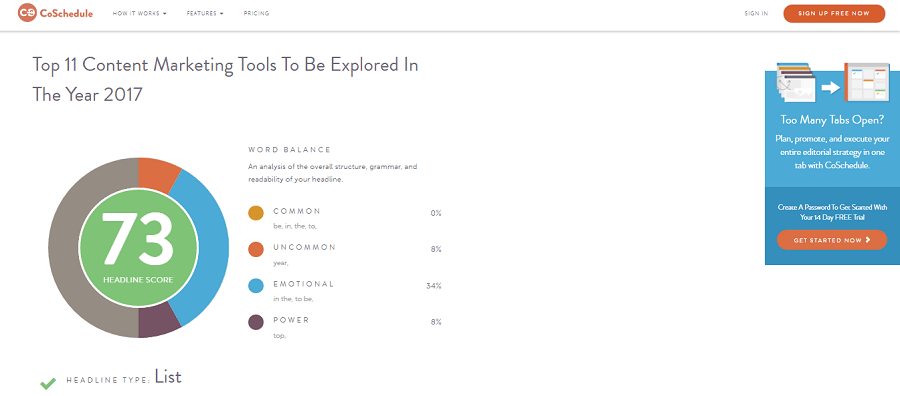
Co- schedule Headline Analyzer is a free tool, widely used in the field of digital marketing. This tool calculates the score for your overall headline quality and rates its ability to result in social shares, increased traffic, and SEO value. It is very simple to operate. The scoring format is also informative. An overall score of your headline is judged on the basis of four parameters; common words, uncommon words, emotional words, and power words. You should definitely use this tool to improve your article or blog headlines.

Coschedule Content Marketing Tool

2. Content Ideator

An easy to operate the tool. Content Ideator helps you find good topics to write about e.g. blogs, articles, and others. It lets you generate content ideas that your audience reads and shares. This tool is also popularly known as a Content Forest tool. The beauty of this tool is it allows you to generate a number of blog topics and ideas in a little amount of time. Once you enter a single keyword or a phrase, it will come up with a long list of ideas out of which some may be helpful and some may not be.

Content Ideator

3. Grammarly

Grammar is of utmost importance to avoid confusions when it comes to oral or written communication. Incorrect usage of grammar and spelling mistakes can actually slow down the overall flow of communication. Grammarly is yet another powerful tool that helps you correct your content. It highlights the most possible grammatical slipups, wordiness, and suggests better articles/prepositions strengthen your content. It also provides apt synonyms for the words that you double-click. This content tool helps you with the correction part of your content. Moreover, it also helps with the correct sentence formation part of your content if you are mistaken at any of the sentences.

Grammarly

4. HubSpot

This specific tool promotes inbound marketing platforms. It consists of various tools to monitor and devise effective blog posts, personalized landing pages, and other compelling content along with excellent consumer support. It also includes effective content-marketing campaign activities. HubSpot also helps social media analytics and message-scheduling so that you can advertise your content easily to your social carriers.

5. Buzzsumo

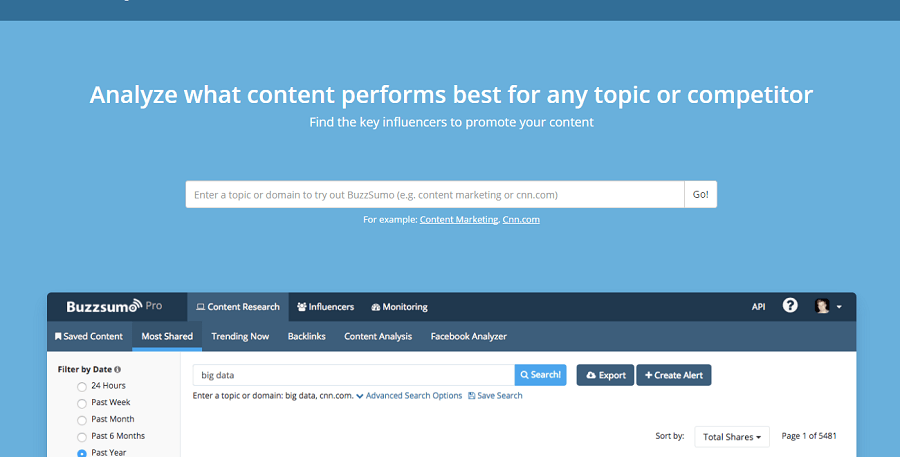
Buzzsumo is a great and invaluable content creation tool. The first five searches of Buzzsumo are absolutely free. If you would like to identify which online outlets or influencers are getting the most traction in your space, you should definitely look to Buzzsumo for analytics-driven insights.

Buzzsumo

Based on your search, Buzzsumo will colonize the trending content, which is most social, highest ranking, and most influential. This will give you a perfect idea of how to title your content. In addition, it will help you find out where to advertise your content based on relevant audience reach.

6. Copify

Everyone wish to create quality content. As a business, you need content for everything, from the website pages that drive sales to the blog posts that engage customers on social media. It does require a good amount of relevant research. Based on the research, you can come up with the draft content. Post that proofreading, copy editing, substantive editing, and designing finally shapes your final output. As you can see, it’s a lengthy process and a challenging job!

Imagine neither you are a professional writer nor you have an in-house writer. No need to worry, a simple solution is just a click away, Copify. As an entrepreneur, you can easily access quality copywriters through Copify. Copify helps businesses to source quality content from a network of approved writers, promptly and hassle-free. They do take responsibility for proofreading and formatting and deliver mostly within 48 hours.


Do Not Miss: to Read About Important Boost Traffic with Content Marketing


7. Outbrain

Outbrain is the best option to solve the problems in the distribution of your content. Even though it is a paid tool, it will broaden your audience to a huge extent.

With Outbrain, you can easily increase your audience engagement with your videos, articles, blogs, articles, and infographics. Your posts will be advertised as suggested posts besides other articles.

Outbrain

8. Canva

Struggling and juggling with the creation of images? Then you should use a tool called Canva. This is considered as one of the most preferred content marketing toolsCanva offers ready-to-use templates, custom image sizes for all social media channels. It provides a drag-and-drop interface, cool fonts, and many user-friendly features. The images created by Canva are absolutely original and exclusive that you witness on the web.

9. Hemingway editor

Hemingway Editor is yet another important tool, which you should not miss. It points out the general concerns pertaining to complex words, vague phrases, lengthy sentences, too many adverbs, too many nouns, and others. Precisely, it helps you to eliminate your language-related errors and make your content simple and easy to understand. While highlighting errors, it also gives a description that why it is an error. The only limitation is that it just points out issues, doesn’t provide solutions or alternatives.

10. ClearVoice

ClearVoice allows you great flexibility and competence; it is a complete content marketing network. You will get an inbuilt market through ClearVoice. It helps in promoting your content and brand. It allows you to create your content and get connected with the brands in order to produce quality content. The studio of ClearVoice enables the brands to recognize the influencing factors and their competitors so that they can produce the content which is both relevant and valuable.

11. Pocket

If you are looking for a perfect content curation tool, the pocket is an apt solution. This content marketing tool includes the search, arrangement, and share the function of the most relevant and high-quality digital content.

Pocket safeguards all of your articles, images, charts, and videos at a single place for reference. It aids you to bookmark your content, ranging from blogs and articles to images and posts.

Conclusion

With the growing competition of quality content, it has become necessary that you publish your posts with accuracy and efficiency. There are lots of content marketing tools available on the web that will help you optimize your content and make it perfect to be published on social channels.

How to boost traffic with content marketing?

Content marketing is of utmost importance because it serves you in generating leads and building a vast community. In addition, it will not make you look like a salesperson. Ignorance of the content is ignorance of the sales.

B2b markatering fact forbes

According to Content Marketing Institute, 70% of B2B marketers plan to create more content in 2017 compared to 2016.

The below-mentioned tips do not follow any particular order, but they all are a package that will give you success in your digital marketing campaign.

Use these tips to inflate your content marketing to boost your web traffic.

1.    Use various interactive platforms like Quora

Content marketing has a lot to do with social media and especially interactive platforms. There are multiple platforms where questions and queries are openly shared and millions of people truly attempt them to satisfy the query. Such platforms include Yahoo, StackExchange, Quora, and others. To boost your content knowledge and thereby raising content marketing results try to contribute to such sites and interact with people. Such platforms are growing rapidly and they can very well help you find a new audience. In addition, these sites will also help your target audience reach your website.

How to use Quora for content marketing

You can promote your content across these sites by following the simple course of action.

  • It is best to follow influencers. Read their posts and try to analyze the way they have written. At times, they serve as the best tutorials in finding out how to write and how to get more thumbs.
  • Start replying to a few relevant topics which are in line either with your services or with your blogs.
  • While replying to the relevant topics, you can include links to your blogs. However, in NO circumstance, it should sound self-promotion.
  • Initially, try to post succinct content so that anyone can read it even while surfing the page. Later on, depending on the question and comfort, you may even post lengthy content.
  • In case your readers will find your content interesting, engaging, and informative, they will surely follow you till your website to check out your own blogs.

2.    Makeover your old blogs

Though it is true that old content can also drive traffic, it is equally important to keep your old content updated and in line with the trends. Each blog listed on your website, be it fresh or old, should have valuable, relevant, and right content.

drive traffic from old content

Your main aim behind the blog posts is to convert your readers into your subscribers. When a reader visits your website for some information and what if they find that your content is stale and irrelevant? It will simply cost you by making you lose your audience. Losing a valuable visitor and subscriber is of course not a welcoming thing. On the other hand, search engines always update their algorithm. There are prominent chances that your site may get penalized if you are not up-to-date.

You can make a few amendments to your existing content in the following suggested manner:

  • Rectify all minor and major grammatical issues
  • Incorporate trends that are new and relevant to your blog title. At the same time, delete which is now not relevant based on the recent updates and algorithm workings
  • Only use images that are relevant and search engine friendly.
  • Identify the keywords that are actually performing well for higher rankings. You can use SEMrush tool for the same
  • Periodically moderate comments on your blog posts.
  • Identify the well-performing posts using blog analytics. Observe a number of views for the specific post.
  • Keep an eye on the number of shares of your blog on social media.
  • While updating the old blog post:
    • Do not modify URL
    • You may amend the blog title but ensure to retain the keywords.
    • Assess meta-description if it can be improved.
    • Provide internal links to your new posts for strengthening internal linking

3.    Use compelling infographics

infographic in content marketing strategy

A picture can portray 1000 of words. This is a sort of ‘not-to-miss’ in your effective content marketing strategy.

Infographics should contain no more than 5-6 statistics/ points of information. Research by KISSmetrics found that any more than 6 and it becomes too much for the reader to consume.

Keep these guiding principles handy while creating valuable info graph:

  • It should be easy to embed to enable more social media shares
  • Use odd numbers in your title to catch attention. E.g. 243% hike (instead of 250%). Odd numbers always do better than even numbers
  • Instead of writing long stories, present short, crisp, and catchy phrases/sentences
  • If your infographic has information in list format, e.g. “5 SEO techniques ”, ensure to label each point with numbers.

4.    Make your brand creative with a variety of content

No doubt content marketing is all about blogging, eBooks, articles, and other content in written format. These strategies are going to stay for long and probably forever. However, do not miss out on the new bud of content marketing; video content.

Content and video in content marketing

Video content will enhance revenue in 2017 and beyond. Marketers who use video grow their revenue 49% faster as compared to non-video users. According to Cisco, 69% of all consumer Internet traffic will be the result of a video. A video is for sure the future of both content marketing and SEO.

While creating effective video content that makes your brand more creative, do not miss out to ensure:

  • Your content voice is in line with your audience voice
  • The video has been designed corresponding to your goal and it serves the purpose
  • Video content contains the kind of emotion you need to drive with
  • It does have a strong CTA; it should provide a way to the user to take some desired action. Sometimes it is also better to have lead capture set up with the best possible minimum fields. For example:
e-mail video combo
  • Last but not least, it fulfils all possible SEO criteria, e.g. usage of relevant keywords, optimized titles, wise usage of tags, proper description, and others

Conclusion

So far, content marketing has grown from marketing activity to an approach of marketing. It is nothing but creating engaging content to inform your target audience about your offerings and drive them to your website. Follow the given guidelines and enjoy the boost of your search traffic and sales.

Most Important SEO Trends

Finally, we are in 2017! New Year, new hopes, new resolutions, but the same old passion! 2016 was a passionate year, predominantly when it comes to Search Engine Optimization (SEO) trends and Google in particular. With each New Year, search engine portals develop new algorithms and rules with a view to fighting spamming links and people trying to play the system.

The SEO industry is always poignant, so it rewards to be aware of these evolutions.

An exciting year for SEO, with the following trends heightening the limelight:

1. Accelerated Mobile Pages (AMPs) will rise

Over the past few years, easy access to mobile has restructured SEO. Mobile search is growing at a rapid pace. In addition, there is not any sign of its getting slow down in the near future. There is a significant shift in website traffic. Searchers are moving away from desktop towards mobile devices. There are many websites which attract major traffic from mobile devices. Google has experienced that mobile searches surpassed desktop searches.

how to set up AMP pages in SEO

The same was reported in May 2015. Since then, many steps taken by Google have indicated that mobile should be measured as the default user experience. In fact, Google has initiated measures to make its index mobile-first. Google favours the websites which have switched over to AMPs. AMP is an open source initiative that aims to provide mobile-optimized content. It provides the capability of loading sites instantly on mobile devices four times faster along with eight times lesser data usage.

15 of the 24 hours in a given day, more mobile search is performed on mobile than on Desktops or tablets. searchenginejournal.

Mobile optimization is already extremely important in SEO strategies. However, it will prove to be mandatory in 2017. Experts have anticipated seeing more preference for AMPs in search results. More and more brands are anticipated to take advantage of this option.

2. Intense content will mount

Don’t optimize for keywords. Optimize your content. Readers are tired of surfing the messed up content again and again. Initially, content marketing efforts were focused on producing as much crisp content as possible. However, over the past few years, the focus has also been laid towards comprehensive content.

SEO-content-strategy

Interestingly, the current market is flooded with both sorts of content. The trend in 2017 will have much focus on optimized and intense content. The users will receive maximum possible information in the minimum possible space. Epic content is surely going to appeal to the readers.

3. Video Content will enhance revenue

Approximately 64% of the consumers are more likely to buy a product after watching a video about it. Video content is at its peak and it is not going anywhere soon.

According to Syndacast,74 per cent of all internet traffic in 2017 will be video.

In fact, the Facebook higher authority also stated that video will become the main type of content by 2020. Along with the development and increased usage of advanced technologies including, Snapchat, Vine, Periscope, and even Instagram, video content is going to last its impression in 2017 as well.

At present, marketers who use video grow their revenue 49% faster as compared to non-video users. Google is experimenting with video ads in the search results.

importance of videos in SEO

There are multiple types of video content including advertisements, webinars, tutorials, question answers, quizzes, and others. Marketers can implement such types of videos in their search marketing strategy.

4. Structured Data and Schema will have an influential role

Search engine crawlers need to understand the web content to provide the best search results. With a view to providing such information to the user, Google, Bing, Yandex, and Yahoo! collaborated to form Schema.org. The inclusion of Schema markup in a user’s HTML improves the way his page displays in SERPs by improving the rich snippets that are displayed below the page title. Schema.org provides particular set shared vocabularies that webmasters can use to markup their pages in ways that can be understood by the major search engines.Look for structured data and Schema are expected to have an influential role in SEO in 2017 and ahead.

5. Voice Search will mark a footprint

Voice search is definitely not a new thing; however, till recent past, it had no significant role to play in the industry of search engine marketing. Conversely, with the increasing usage of mobiles and other advancements in technology, voice search is gradually gaining drive.

The study, based on results obtained by 1,400 US residents, showed that 55 percent of teens use some kind of hands-free search on their smartphones every day, such as Google’s own solution, along with Apple’s Siri and Microsoft’s Cortana. While voice search use is growing among older smartphone owners, 45 percent of adults in the survey claimed to fee “like a geek” when they talked to their smartphone.

 Google via PR Newswire

Obviously, to search for anything rather than typing out the word or phrase, it is a lot more convenient to just speak. Searching through voice is going to grow more in 2017.

how to optimize text for voice search

However, to optimize search engine marketing strategy, you need to ensure that you comprehend the searchers intent. Voice searches will usually be in the interrogative form and would be including question words like who, what, when, how, where, and others. The best way out to optimize if rephrasing headlines and make it look like a question rather than a statement. For example, “Tips for social media marketing” can be better rephrased as “What are the best tips for social media marketing?”

6. Influence of artificial intelligence on algorithm working

Finally, late last year, Google search algorithms got a boost on the release of Google RankBrain. Google RankBrain is a machine-learning artificial intelligence (AI) system which assists in processing search results. It is anticipated to make search smarter and more pertinent to the user. To get along with the flow, use taglines, compose compact articles and reduce the amount of the information you post.

Industry experts are expecting more machine learning updates similar to Google hummingbird in this year as well. Machine learning updates may get released in the areas of data interpretation or marketing automation. Though these are anticipations, they are unquestionably an important portion SEO trends for 2017.


Do Not Miss: to Read About Important Link Building Standards


7. Optimization for user intent

Sites which lay emphasis on enhanced user experience are always favoured by Google and other search engines. To some extent, user experience matters when it comes to SEO. It is straightforward that users will spend more time on the site if they find it user-friendly. Even though keywords and phrases are vital; in 2017, brands are also required to place significance on optimizing their digital content on the basis of user intent. In your SEO strategy for 2017, three musts are:

three keys for optimizing content

8. Personal branding – an undisclosed SEO strategy

A social media platform like Facebook has refined its algorithms to favour individual posts over branded posts. In addition, it is continuing doing so. This indirectly places an emphasis on personal branding. Personal branding strategy is very similar to the strategy of corporate branding.

According to Forbes, with the help of a personal brand, you’ll have an easier time securing guest posts, building user trust, and driving more traffic to your website.

Surprisingly, quite a low number of brands have actual cash on it in their SEO activities. However, it would not be incorrect to anticipate that more and more businesses will attempt to cash on personal branding. At the same time, personal branding will bring in more opportunities and more competition.

CONCLUSION

Of course, it is not an easy job to predict what exact changes Google and other search engines are going to announce this year. However, it is not that tough to anticipate that the aforesaid trends will probably widen in some consequential way. As an SEO marketer, you need not to immediately refurbish your digital marketing strategy but need to factor the upcoming trends with a prolonged vision.

The year 2017 will be an influential year in many ways. Get yourself well ready for future challenges and future opportunities.

5 Ways to Use Social Media Automation in your Marketing Strategy

Automation – keeping things simple, and making them faster

We are now in 2017, and the era of Social Media automation is truly upon us. Today, we witness a number of scheduling tools for various automation tasks. Such tasks include automation of e-mail responses, automation in industries, automation in banking services – in a nutshell, and many others. A pretty big chunk of the average person’s day is dependent on automation and automated processes. Automation, in itself, is an invaluable tool to boost productivity.

Social media – Killer Shark or a Marketing Runway?

Ask anyone born post the ’90s where the real dynamism is. A great majority of them will tell you it is social media. However, over two-thirds of marketing executives cringe at the very mention of social media. This is because of the overload of social media. Its intrinsic ease of access is, strangely enough, killing marketing. However, on the other hand, it is also enabling a rebirth for marketing, in the form of social media marketing.

marketing-runway-for-social-media-marketing

Let us move towards what exactly social media marketing is. Today we see many small businesses, libraries, and stores purely run based on their social media presence. Moreover, nowadays, we see companies use various channels of social networking to create a self-sustained marketing model for themselves. The more the employees post on social media, the more potential gains the business stands to receive.

The use of social media is not quite universal—but it is getting close. 70% of the U.S. population now has at least one social networking profile, while more than half use two or more social networks. According to CMO survey, the number of global social media users is projected to grow from 2.1 billion in 2015 to 2.5 billion by 2018.

The following pie describes the impact of Social Media Marketing on businesses

social media marketing comparison graph

A dose of insight:

Social media marketing now plays almost as large a role in purchasing decisions as does TV, and 57% of consumers say they’re influenced to think more highly of business after seeing positive comments or praise online.“

Still, some fascinating contradictions remain. Even though businesses today use social media for marketing and those efforts are expected to increase, many marketers and top executives alike find the business value difficult to quantify through this process. Today, as social media is speeding along at a lightning pace, marketing executives are huffing and puffing along in its wake. Now, it is time for marketers to catch up.

That is where the brainchild of the two – social media marketing and marketing automation – comes in. Say hello to ‘social media automation’!

When the worlds of social media and marketing automation hit into one, a union of convenience and connectivity is achieved. A broad bandwidth of experts in this domain does seem to concur with this fact. According to a recent study by Marketo91% of the most successful users agree that marketing automation is “very important” to the overall success of their marketing efforts across channels.

Five rules for social media automation

Today, a major amount of our time is mostly spent staring at screens. It seems that this trend is here to stay for long. The devices and their screens are getting more and more sophisticated as well. Keeping that in mind, here is the nitty-gritty of social media automation.

1)Post When Your Audience is up and surfing

The chances of getting higher traffic to your posts are obviously higher when your audience is online. Each business (and social network) is unique. The only way to know the best time to post is to dig into analytics. Once you are well versed with the knowledge of perfect posting times, it becomes easier for you to make data-driven decisions. Rather than throwing posts out hoping for an outcome, better you predict it. Based on our research, we highly recommend a tool called True Social Metrics if you need to understand when and how your audience is spending their time on the web.

bes time to post on social media marketing

Once you know your best time to post, you can then use a tool like Post Planner or Sprout Social – both are excellent social media management tools. Usage of these tools can help you plan or schedule your posts at specific intervals.

When content is added to a unique plan, it is then scheduled based on the pre-determined times. It can also help you sort out the best posting times depending on the type of content you are creating. No huffing, no puffing anymore! Just let your system do all the hard work, while you get some downtime!

The buffer is another important social media tool used to optimize social updates. which conveniently helps in scheduling posts on various other social media platforms such as Facebook, Twitter, Google Plus, LinkedIn, and others. It also helps in spreading scheduled posts out to publish throughout the day and engagement time.

There you go, an easy way to save a whole lot of time and effort! What are you waiting for, then?

2)Automate to drive it home: Evergreen Content

Your evergreen content is your bread and butter. This aspect of your website never gets old. In simple words, evergreen content is material that is considered fresh and exciting to your readers. It adds value to your audiences, no matter when it is posted. A tool we found to be very nifty when it comes to posting evergreen content is Tailwind. Pin your freshly churned content – be it a blog, a page, an article or a quote. Let it keep showing up on your social media pages.

3) Set up automation meetings between your heroes: multiple social networks

Perhaps another fundamental feature of automation in general, extending even to social media automation is inter-connectivity. As a marketer, you can set up a linked list of operations based on triggers. By combining one social media network with another, you can achieve greater returns and attention to your posts or websites. With a tool like IFTTT (If This Then That) you can share your Instagram post over Twitter for a wider band of users to see.

4) Set up notifications -to keep you up to speed!

Do you know that annoying pop-up which keeps appearing on your smartphone? Well, a similar feature can be implemented here as well! Except, who has the time to interact, respond, and stay engaged all the time? Timing is essence here. To stay up to speed, you need to initiate automated notifications. One such useful tool we came across is Twitonomy. Twitonomy helps you manage your mentions over Twitter, but more than that – you can see your most influential, engaged, and active users (provided you shell out the bucks for a paid version). The beauty is in its ease of use. Find a mention, click on the tweet, respond, follow, or even add to a list. Within a matter of seconds, you can interact with your audience and stay in the conversation.

Set up notifications -to keep you up to speed!

This graph depicts that an average of 68% of social media fan posts is ignored. Here is where you can get ahead of the rest. Just by being responsive and responsible, all without your own precious time being wasted!

TweetDeck is a successful and totally free desktop web app. It is the best fit for those who need to manage varied accounts, follow specific hashtags, respond to lots of distinct users, and see precisely what’s being tweeted in real-time.

On the other hand, Followerwonk is used to explore and grow your social network. It does deep digging into Twitter analytics and let you know who are your followers? Where are they located? When do they tweet? Which tweet gets more fame?

5) Don’t let it do all your work!

It is easy to get carried away these days, isn’t it? Well, automation is a time-saver, perhaps a lifesaver for so many of you marketers! However, having a portion of your work automated doesn’t mean you kick back and grab a breather. Indeed,  social media management tools are surely here to stay, but only because they free up your schedule from monotonous work. Use this time wisely to interact with your customers, to spread your content, and to build relationships!

Finally, since you do spend most of your time on social media anyway, why not utilize that to improve your productivity – as funny as that sounds? That is why, for growing businesses, developing a social presence through automation is perhaps a leap of faith they can afford.

Remember, It is never too late to start!

11 Marketing Automation Basics to Boost Your Business Growth

Congratulate yourself if this is probably the first time you are hearing of Marketing Automation and you own an online venture or blog. Marketing is increasingly integrating with technology and as experts advice; marketers will soon be spending more on technology than Tech specialists. Marketing automation, with the help of platforms and technologies, helps marketers reach the relevant audience, analyze activation performance and deliver measurable results.

One of the biggest trends for businesses this year, marketing automation can help your online business analyze the impact and manages your marketing campaigns. It can also collate customer data to help further leads conversion. And the greatest advantage that you can gain over your competition is implementing this before them.

A Dose of Insight: Less than 5% of non-tech companies are currently using marketing automation software which opens up a wide opportunity for your business.  (Source: venturebeat.com)

Here are the basics of marketing automation to get you started

Part I: Understand your customer

what-are-the-criteria-for-coustmer-tracking

Track Users with Cookies

One of the widest used marketing automation features is tracking the user across websites to nurture, qualify and finally convert a lead.

Study What Customers Do on Your Website

With predictive tools rooted in real-time data analysis, you can gather data on your customer’s purchases and habits. With a clear emerging pattern, you can act on such insights to increase conversion and subsequently sales.

Understand How Your Consumers are Different

Traditional marketers also use segmentation as a tool to understand their consumer base. This aspect of traditional marketing is equally important to consider for online marketing. With intelligence from segmentation, you know the products which might be more pertinent to a particular segment of your customers.

Reach Your Customers at the Best Time and Day

Marketing automation software can even deliver your e-mail campaigns to you customers’ inbox the time of day and day of the week when they are most likely to check their e-mails.

Part II: Engage With the Customer

engagement-with-the-coustmer

Use intelligent and personalized contact forms

Marketing automation platforms enable you to collect a lot of information about the visitor on your page. Converting them or gathering the most relevant information such as their phone numbers can be easy with a customized call to action highlighting the product or service they are interested in (already clicked on).

Remarket with Customer Data

Use ad networks to talk to your customers and further your engagement with the customer. You may remind them of their last action on your website and further your lead to conversion.

Don’t Forget Offline Online Integration

If you have an offline store, to make your online pitch you must customize your online content and ads to your customer. The data from your CRM can help you segment and better advertise to the same customer online.

Never Ask Twice for the Same Information

You must never ask your customers for any information that you have. For instance, if you already have a visitor’s contact details from your marketing automation tool, make sure that the contact form does not pop up in this case.

Part III: Close the Deal with Marketing Automation

how-to-close-the-deal-in-marketing-automation

Reminders about Abandoned Transactions

The average abandonment rate for online shopping carts is at a high 67%. You can recover these lost leads and potential revenue by automating you’re tracking and setting up visual reminders on other websites or through e-mail. An automated follow-up e-mail receives a higher open, click-through and conversion rate. The conversion rate using abandoned cart e-mails can go up to 40%.

Update Customers about the Price Drops

A few of your customers may abandon cart due to the price. Automating a personalized e-mail to such customers increases the chances of conversion up to 6 times. They have already established the purchase intent and you could capitalize on it by sending them emails whenever there is a price drop on the products they inquired for.

Reward the Engaged Customer with Discounts

A new format of loyalty programs being used by online portals is adjusting discounts based on user activity on their website. For instance, a website may offer an engaged active customer who regularly visits a website. Leaves reviews and feedback with a special additional discount. Web sites may also want to e-mail discount codes, marketing offers to engage and make active some accounts which have been dormant for a long time.

Marketing automation after all this may sound like a magic wand however, these can’t be one magic glove fits all as a solution. Before you decide to buy a Marketing Automation Tool, research and understand the features you need and the features you don’t. Have a plan in place and understand both its’ strong points and limitations. From your selected vendors (each of which will have their own advantages and disadvantages), ask for free trials and plan to launch accordingly to see what works for your business. Some of the known brands in market automation include Oracle (formerly Eloqua), Pardot, Infusionsoft services, Marketo, Hubspot, and Sales manager.

Read More OnWhat is Marketing Automation